§ Rutherford County · 9.5 mi from Murfreesboro
Foundation repair in Kittrell, TN
Kittrell sits on some of the stoniest ground in the county, with limestone right at the surface in places.
Last updated
Kittrell at a glance
- Drive from Murfreesboro
- About 10 miles east on US 70S
- County
- Rutherford
- ZIP code
- 37149, shared with Readyville
- Mapped soil at community center
- Gladeville and rock outcrop complex, extremely stony
- Depth to rock in Gladeville soil
- About 10 inches
- Rock outcrop share of that map unit
- About 31%
Drive distance: OpenStreetMap routing from central Murfreesboro. Soil: USDA NRCS Soil Data Access, map unit at the community's center point. Soil maps describe typical conditions, not your lot. History: Wikipedia, Kittrell, Tennessee.
Two quick answers for Kittrell
Can piers be installed in Kittrell's rocky ground?
Often, but they may stop very shallow. Gladeville soil, mapped at the community center, reaches rock at about ten inches, and about 31% of that map unit is rock outcrop. The contractor should confirm each pier is bearing on sound rock, not a loose ledge, and record the depth of every one.
Should I get an engineer for a Kittrell foundation repair?
For a large or confusing job, yes. An engineer's plan gives every contractor the same scope to bid on and protects you if the first fix does not hold. A structural engineer's report usually costs $300 to $1,000, according to Angi. On rocky ground like Kittrell's, it can also settle questions about pier depth.
Free inspection
Seeing any of this in Kittrell?
Tell us what you see. One licensed local contractor will come and look, free.
Rock at the surface
Kittrell is an unincorporated community on US 70S, about seven miles east of Murfreesboro by the straight road. It is named for Major Marion B. Kittrell, who moved to the area around Cripple Creek in 1874. Uncle Dave Macon bought a home here in 1900 that still stands.
The ground is the thing to know. The USDA maps the center of Kittrell as a Gladeville and rock outcrop complex, labeled extremely stony. Gladeville soil reaches rock at about ten inches, and close to a third of that map unit is exposed limestone. In plain terms, this is shallow, rocky ground. A house built here is often sitting on rock under part of its footprint and on a thin clay pocket under the rest.
What that means for repairs
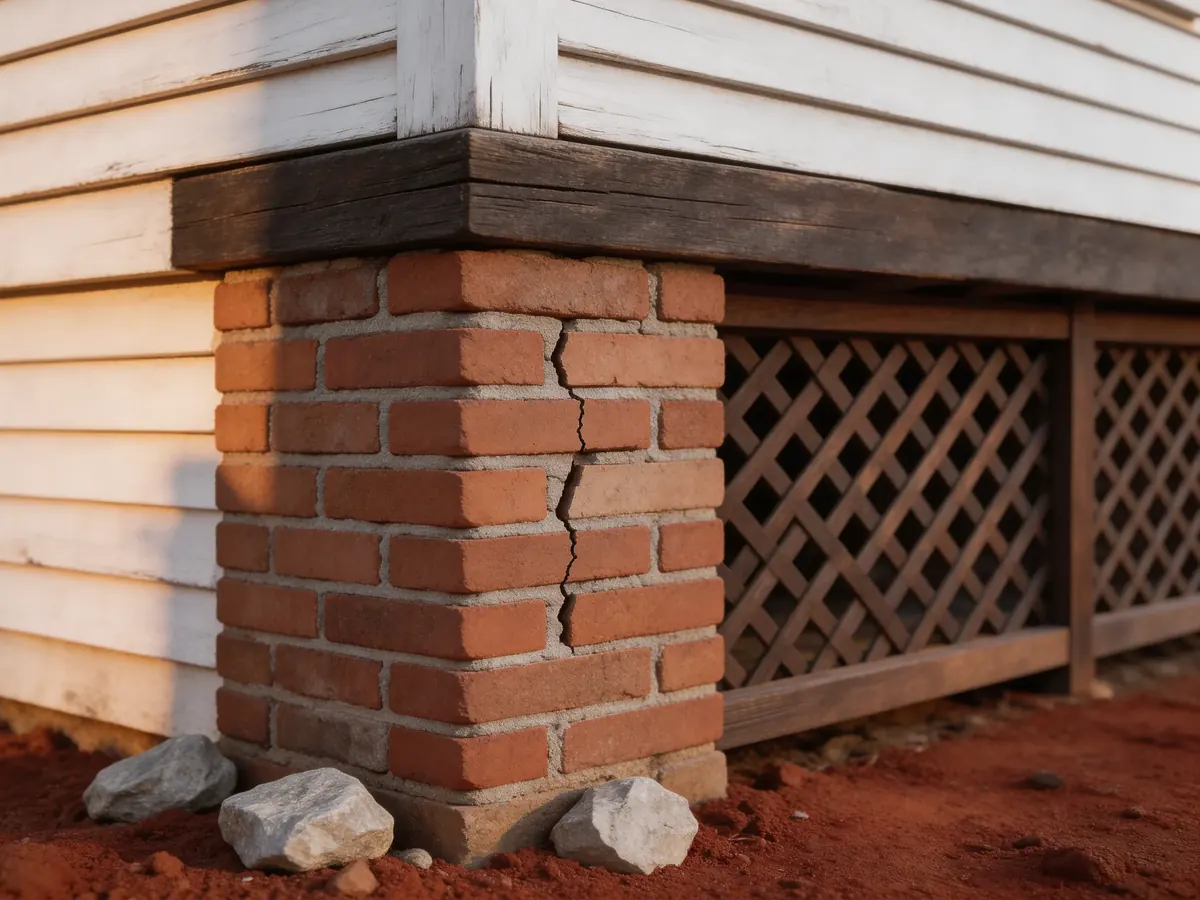
Thin soil over rock is a mixed blessing. Footings on solid rock barely move. Footings on a clay pocket between ledges can move a lot, because that clay wets and dries quickly and has nowhere to go. The result is uneven support, which shows up as cracks that run from the rock side of a house toward the soft side.
It also changes the repair. Push piers may hit rock at a foot or two, which can be fine if the rock is sound and continuous, and a problem if it is a loose slab or a ledge with a void under it. Helical piers can struggle to advance in stony ground. Some crews will suggest pinning to rock or pouring a deeper footing instead. Ask how they plan to confirm what the pier is bearing on, and ask for a written record of each pier's depth.
Getting the right crew
Because Kittrell's ground is unusual, it is worth getting more than one opinion, and for a large job it can be worth paying a structural engineer to write the repair plan. We can match you with a licensed contractor for a free estimate. Rutherford County requires a state home improvement license for residential jobs from $3,000 to $24,999.
What to tell a contractor about your Kittrell home
Kittrell is about 10 miles from central Murfreesboro. Ask whether the contractor works this far out often and whether the inspection is still free at that distance. We do not have reliable Census housing figures for Kittrell, so start with what you can see. Vents along the base of the outside walls usually mean a crawl space. No vents and a concrete floor inside usually mean a slab.
USDA soil maps show Gladeville and rock outcrop complex, extremely stony at the center of Kittrell. Soil maps describe typical ground, not your lot, so ask whether the contractor wants a soil test or an engineer's report before quoting piers. Because this is Rutherford County, ask for the contractor's home improvement license number on any job from $3,000 to $24,999.
Repairs we can connect Kittrell homeowners with
National cost ranges from Angi, 2026. See the cost guide for detail.
- 01Foundation repairDiagnosis and repair for settling, cracking or shifting foundations.Most pay $2,225 to $8,133
- 02Pier and helical pier repairSteel push piers and helical piers that carry the house on firmer ground.$1,000 to $3,000 per pier
- 03Slab foundation repairFixes for sinking, cracked or heaving concrete slabs.Slab jacking $500 to $1,300
- 04House levelingLeveling sagging floors and out-of-level crawl space homes.Reshimming $1,200 to $4,000
- 05Crawl space structural repairRotted sills, sagging joists, failing piers and damp crawl spaces.New piers $800 to $4,000
- 06Basement wall repairBowing, leaning or cracked basement and block walls.Basement repair $2,300 to $7,600
- 07Foundation crack repairSealing and structural repair for foundation and wall cracks.Cracks $250 to $800
- 08Foundation inspection and estimatesOn-site evaluations, written estimates and engineer reports.Engineer report $300 to $1,000
Free inspection request
Get a licensed contractor out to Kittrell
Fill this in and we will pass it to one independent, licensed contractor who covers your town. They will call to set up a free visit. You do not have to hire them.
Tennessee requires a home improvement license for residential jobs from $3,000 to $24,999 in Rutherford County, and a contractor license for jobs of $25,000 or more anywhere in the state. Ask any contractor for their license number and check it at verify.tn.gov.
About this guide
Written by the Murfreesboro Foundation Repairs editorial team. The facts on this site come from the sources linked next to them: the U.S. Geological Survey, USDA soil surveys, Census Bureau estimates, Angi's 2026 cost guides and the Tennessee contractor licensing board. Have a licensed contractor or engineer inspect your home before you decide on a repair.
Last updated