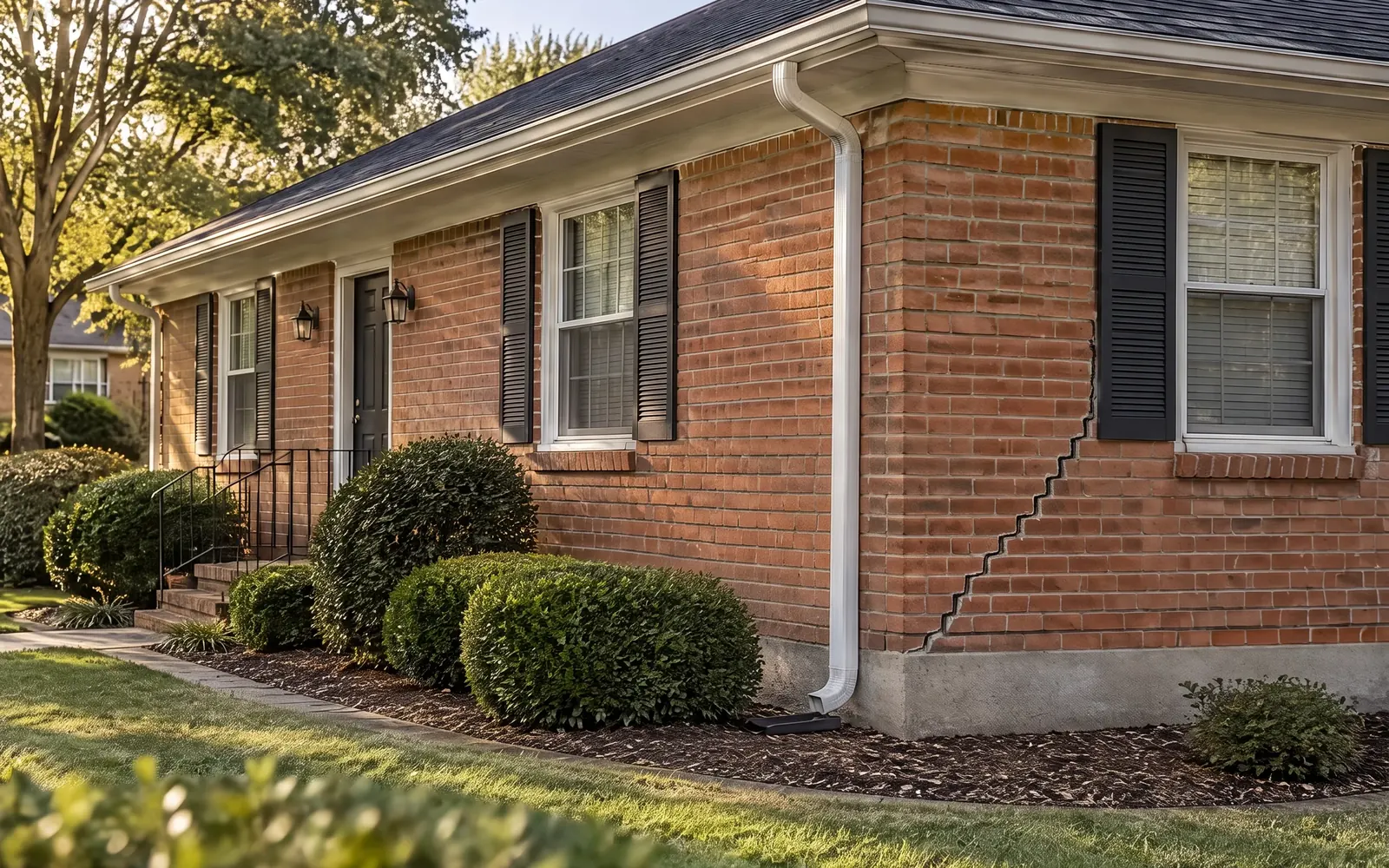
Signs your foundation may be moving
Foundation trouble rarely announces itself with one big crack. It shows up as a list of small things that start to line up. Doors that used to close fine now stick or swing open. A crack runs diagonally up from the corner of a window or a door frame. Floors feel like they slope when you walk across a room. Outside, brick separates from window trim, or a stair-step crack climbs through the mortar.
- Diagonal drywall cracks above doors and windows
- Doors and windows that stick, or gaps at the top of a door frame
- Floors that slope, bounce or feel soft
- Stair-step cracks in brick or block
- Gaps between walls and ceilings, or baseboards pulling away from the floor
- A garage slab or patio dropping away from the house
- Cracks in a foundation wall wider than about a quarter inch
One of these on its own may be nothing. Concrete shrinks as it cures, and wood framing moves with humidity. Several of them together, or any that keep getting worse, are worth a professional look.
Why foundations move around Murfreesboro
Murfreesboro sits in Tennessee's Central Basin, on limestone. Around the city, the U.S. Geological Survey names the Ridley Limestone, with some Pierce Limestone at the surface. Over a very long time, slightly acidic water has dissolved that rock along cracks, leaving caves, underground streams and sinkholes. The USGS report 2005-5281 on sinkhole flooding mapped and tracked flooding in 78 sinkholes in the Murfreesboro area after major storms in 2001 and 2002. Most houses are not sitting on a sinkhole, but almost all of them sit on soil that formed from this rock.
That soil is mostly clay, and in much of the county it is thin. The USDA Talbott series description, a soil described from a site in Rutherford County, lists 20 to 40 inches to bedrock with a firm, plastic clay subsoil. Clay shrinks when it dries and swells when it gets wet. When rock is close to the surface, part of a footing can rest on rock and part on clay, so the house gets uneven support.
On top of the geology, there are the everyday causes that apply everywhere: downspouts that dump water at the foundation, yards graded toward the house, plumbing leaks under a slab, large trees pulling moisture from the soil in summer, and fill that was not compacted when a lot was built.
Common repair methods
The right repair depends on what is moving and why. A contractor should explain the cause before recommending a fix. These are the main options you are likely to hear about:
- Steel push piers and helical piers that carry a settling footing down to firmer soil or rock
- Slab repair, including piering, foam or mud lifting, and leak testing under the slab
- House leveling for crawl space homes, with new piers, shims or beams
- Crawl space structural repair for rotted sills, sagging joists and failing piers
- Basement wall repair with anchors, braces or carbon fiber for bowing walls
- Crack repair with epoxy or polyurethane injection
- Drainage fixes, like downspout extensions, regrading and footing drains, which are part of most good repairs
What foundation repair costs
Nationally, foundation repair averages about $5,175, and most homeowners pay between $2,225 and $8,133, according to Angi, 2026. Steel or hydraulic piers typically run $1,000 to $3,000 each, and many jobs need several. Our foundation repair cost guide breaks the numbers down by repair type and explains what pushes a Murfreesboro job up or down.
Licenses and permits in Rutherford County
Rutherford County is one of nine Tennessee counties that adopted the state home improvement law. Here, a contractor doing a residential job worth $3,000 to $24,999 needs a home improvement license and a $10,000 surety bond, according to the Tennessee Board for Licensing Contractors. Jobs of $25,000 or more need a full state contractor license anywhere in Tennessee. You can look up any license at verify.tn.gov.
Most structural foundation work also needs a building permit. The contractor should pull it. Ask who will, and be cautious about anyone who suggests skipping it.
How we help
You tell us what you are seeing, and we match you with an independent, licensed foundation contractor who works in your part of Murfreesboro or the surrounding towns. The estimate is free, and you decide whether to hire anyone. Our how it works page covers the whole process, including how we get paid.